Book report: Primed to Perform – Introduction

51B5yNM51AL._SY344_BO1,204,203,200_
Reading notes by Yan Tougas

Introduction

This book is about creating high-performance cultures.  Culture acts as a primer to performance.  The right culture leads to high performance.  High-performance cultures financially outperform others.  In mediocre cultures, the best laid plans often fail.

There are two types of performance:
  • Tactical performance: the ability to execute against a plan
  • Adaptive performance: the ability to diverge from a plan
A single-minded focus on tactical performance (present in most organizations) can cripple adaptive performance.

Building a culture is not magic.  There is a science to it.  Which means cultures can be measured.  Building a high-performance culture is an intentional act.  It doesn’t happen accidentally.

Why you work affects how well you work.  There are six basic motives behind people’s work:

  • Play
  • Purpose
  • Potential
  • Emotional pressure
  • Economic pressure
  • Inertia

The first three strengthen performance.  The last three weaken it.  The best motivation is inspiration.  Inspiration to find play, purpose, and potential in work.  This is called Total Motivation (“ToMo”).  The best workers are the ones who work for the pure joy of working.  And ToMo positively affects all stakeholders, not just employees.

An organization lacking shared values often turns to money as the value holding the firm together.  Money is a weak glue.  It is an indirect motivator.  High-performance cultures realize that purpose, not profit, is the reason a company exists.

Ethical leadership on a page


Ethical Leadership on a page


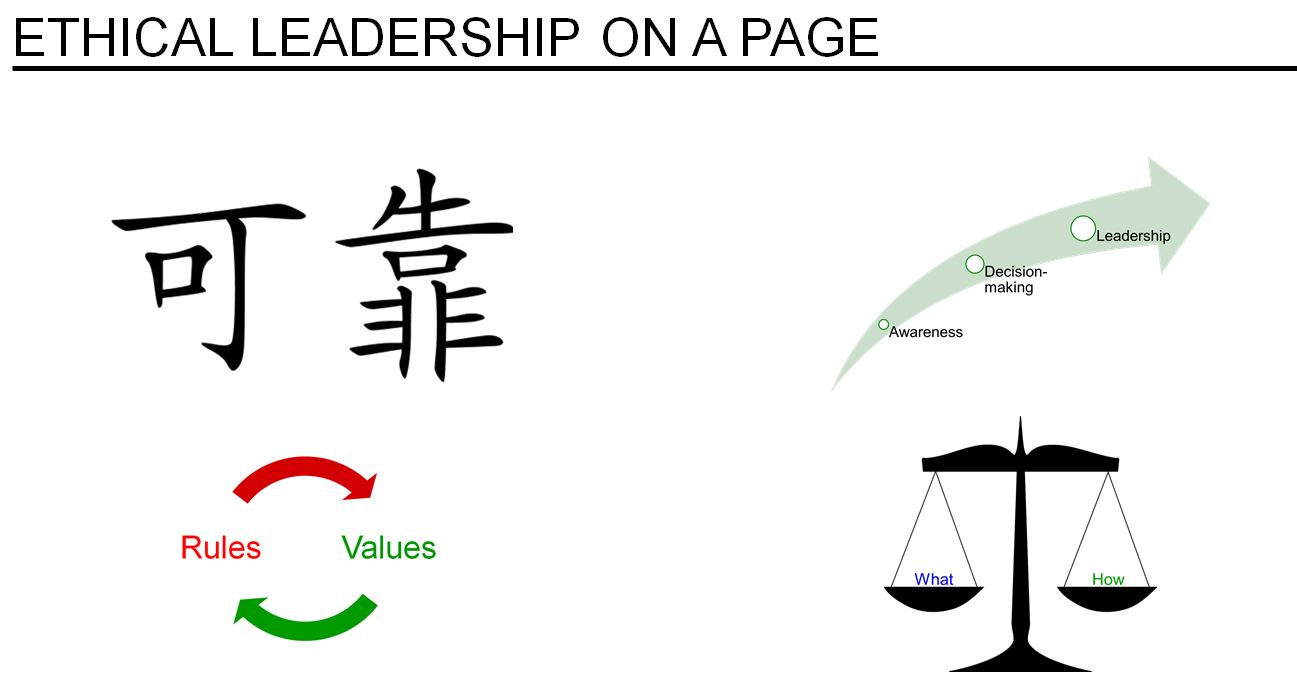
The four images above represent the major concepts supporting a discussion about ethical leadership:

The Chinese symbols for trust ​(or trustworthy, or reliable).  Everything we do either builds or destroys trust.  Building trust should be our priority.

Ethical leadership continuum.  Being ethically aware is good.  Making ethical decisions is better.  Inspiring others to be ethical is best.  It’s all about behavior.

Rules and values are mutually supportive.  Use values when you can, rules when you must.  Values inspire and fill the gaps between rules.  Rules support orderly governance and equal protection.

How we do things is just as important as what we do.  Ethical leaders ask their team members how they plan to accomplish their goals (or how they have accomplished them).  The “how” question sends a strong message about the importance of ethics and compliance.


The Embassy Analogy

I just returned from 3 days in New Orleans where I participated in the Ethics & Compliance Initiative’s Best Practices Forum. I was one of about 100 practitioners discussing how best to evaluate an E&C program.

During one of the roundtable discussions, a colleague asked how others deal with cultural differences around the world. When it was my turn to speak, I offered the “embassy analogy”.

When we walk into an embassy, we legally walk into a new country. The laws of the embassy’s country now apply to us. This is something we need to think about before we walk into an embassy.

Similarly, when we walk into our place of employment, we agree to follow the company’s rules and abide by its values. We might work in a country that doesn’t protect employee safety as much as our company, or allows employment discrimination based on race or gender, or doesn’t enforce its bribery laws. These “cultural differences” should be seen as irrelevant by ethical employers.

In a way, a company is like a tribe. My favorite definition of a tribe is: “People like us do things like this.”* If we refuse to pay bribes – or hurt the environment, or discriminate – people like us will come work for us and buy our products. Others won’t.  And that’s just fine because we don’t want them. Our goal is not to be a company that everyone wants to work for. We just want the people who share our values. Others can go work somewhere else. No one has to work for us.

This attitude should not be mistaken for a belief that our values are better than those adopted by other groups or organizations. Different values could be just as good. And, who knows, maybe we are living by the wrong set of values. The point simply is that we have intentionally chosen our values and living by them should be a condition of employment.

Do you agree with the embassy analogy? Let me know in the comment section below.

*HT to Seth Godin

We don’t need more rules

As business scandals continue to surface, we see more companies looking to hire compliance officers.  So we must ask: do we really need more employees whose job it is to ensure that other employees are following the rules?

Thinking about the recent Volkswagen scandal, would more compliance officers have prevented the deployment of its cheating software?  Compliance officers do their job within a set of corporate values.  If those values don’t include honesty, integrity, and trust, then what exactly is the role of a compliance officer?  The time has come for organizations to discover the values they want to live by, instead of the rules they want to follow.

Ethics Officers more naturally consider culture and values when addressing compliance failures.  Values provide guidance not only in interpreting a rule but in deciding what to do when no rule governs.  That’s why values-based organizations will always outperform, and outlive, those that are rules-based.  In the aftermath of an ethical scandal, organizations regain none of the public trust by hiring a large outside law firm.  To regain trust, organizations must publicly commit to live by a set of clear values.  And they must be willing to lose business rather than compromise those values.

Don’t play it safe

The typical corporate policy is rules-based and the average compliance training is boring.  You don’t inspire employees to do the right thing by numbing their hearts and minds.

Ethical leaders connect with others by being real.  They get emotional, personal, vulnerable.  They say “People like us do (or don’t do) things like this.”  They take a stand and invite others to join them.  Ethical leaders don’t play it safe because safe is uninspiring.

Even the most values-based companies do things that are not aligned with their values (i.e. no one is perfect).  Ethical leaders identify those behaviors and work to change them.  It’s risky, but the rewards are deeply satisfying.

Ethical outliers

Today, the ethical leader is the exception, the outlier.

Most people are ethically aware.  They recognize an ethical dilemma when it is staring them in the face.

Fewer are good ethical decision-makers, having both the wisdom to make the right call and the guts to execute.

Fewer still can execute in an inspiring way, drawing others in their tribe.  These leaders are the most valuable asset an organization can acquire today.

And in this connected, transparent world, they can easily be discovered.

Get yours today.

On ethical leadership

The ethically aware recognizes ethical dilemmas when they show up in her life.

The ethical decision-maker knows how to properly resolve those dilemmas and take meaningful action.

The ethical leader executes in a way that inspires others to become ethical leaders themselves.

Ethical leaders are a rare breed.  Ethical leadership requires emotional work.  The tasks cannot be detailed in a procedure manual.  Ethical leadership is an art.  It must be willed.