A school district in Pennsylvania recently sent letters to families who had not paid for their kids’ school lunches and the letters essentially read: “Pay up or we’ll take your kids away.”
This story reminded me of all the managers who once told subordinates who were struggling to meet a business goal: “You better meet this goal or I’ll find someone else who can.”
In either case, the better move is to ask: “What can I do to help?”
Any leader would know this if they simply asked themselves: “Who do I want to be?”
“Expert networks” are organizations that connect companies to academics, corporate executives and government officials to provide valuable, hard-to-get information.
Anyone trying to learn about an industry can save a lot of time by using an expert network. With just a few meetings, we can understand the market, the players, the risks and the opportunities.
But what if an expert network contacts one of your employees for information about your business? How prepared are they against sharing information that could put your intellectual property at risk, or violate privacy laws, or drag them into an insider trading probe? After all, many hedge funds use such networks to gather intelligence and your employees could be offered $1,000 for an hour of their time.
Most employees don’t know what an expert network is or what it looks like (did you, before reading this?). The email invitation they receive will be flattering, painting them as experts in their field. Their natural inclination to help could make them agree to a call and the promise of a nice payout might break some of their defenses.
After 15 years in ethics & compliance, I love to hear a story of bad behavior that I’ve never head before.
I know it sounds weird. Clearly, I’m not rooting for the bad guy. It’s just that when you’ve heard a thousand stories about stealing from the petty cash or failing to disclose a conflict of interest, anything new… well… spices up your day.
So I was tickled a couple of weeks ago when a colleague from a different company told me about a case she was investigating. It turns out that a manager at a small, remote location, wrote a fake policy manual to help him accomplish his evil plan. He wrote a number of policies that contradicted the Big Corporate Policies and told his team that these were the new policies from Corporate. The team didn’t like the policies but they were accustomed to following the rules so they just complied.
I have to admit that this was a bit clever. Why try to convince a bunch of people to help you violate existing policies, or try to do it on you own undetected, when you can simply change the policies and steal in broad daylight?!
This story reminded me of the importance of ethics in an organization. Being ethical can sometimes mean that we have to resist unjust laws or policies. It’s not because Corporate wrote a policy that it’s automatically a good policy. If something is wrong with it, employees must speak up.
I can’t help but wonder if something like this is happening in my own organization. Have we done enough to foil such a scheme? Are we communicating enough about our real policies so that employees can recognize a fake one? Do we have reporting channels that employees feel comfortable using? Is our culture such that a manager would never dream of doing such a thing?
I recently returned from the latest ECI Fellows meeting, which focused on behavioral ethics. This post is part of a series where I share my insights and lessons from the meeting.
I love paradigm shifts.
I love how they tickle my brain and put me in a state of awe.
My favorite ones are the shifts who force me to see myself differently. It happened recently when someone told me I was a “choice architect.”
Choice architecture is often associated with consumer influence. But the practice goes beyond lowly tricks to make people spend money they don’t have to buy stuff they don’t need to impress people they don’t like. For example, we use round tables to foster group discussions. Or we paint lines on the road before a steep curve to provide the illusion of speed and make people “choose” to slow down.
It turns out that similar tricks can make people more ethical. If we ask employees to promise to tell the truth before they complete a questionnaire, they will be more truthful than those who certify after the fact that they have answered truthfully. If we create a cross-functional team, its members will consider a broader set of ethical perspectives than if we have a homogeneous team. If we place tent cards about ethical decision-making on conference room tables, more people will raise concerns during a meeting.
I never thought of myself as a choice architect but all ethical leaders must see themselves as such and create environments where ethical choices are easier to make.
Now I can look at everything I do under a new light. I have a new tool. It’s like starting fresh.
I recently returned from the latest ECI Fellows meeting, which focused on behavioral ethics. This post is part of a series where I share my insights and lessons from the meeting.
There is a story about a United States Marine who halted a fellow soldier about to commit a war crime by saying “Stop! This is not what Marines do.”
The Marine didn’t pull out a copy of the Geneva Conventions and point to a specific article prohibiting the conduct. He simply explained that “people like us don’t do things like this.”
It’s tempting to point to the law when we want people to do or not do something. But no one likes to be told what to do. We’d rather feel in control. At the same time, we want to belong, we want to be part of a group where “people like us do things like this.”
Consider this the next time you write a policy or create a training or implement a control. Are you pointing to a force external to the group (like a law) or are you drawing on a tribal bond? One is stronger than the other.
I recently returned from the latest ECI Fellows meeting, which focused on behavioral ethics. This post is part of a series where I share my insights and lessons from the meeting.
Behavioral science has demonstrated that it is easier for people to rationalize unethical behavior when they are not the one doing it.
For example, a child might resist the temptation to steal a dollar at home to buy cookies at school. But if her big sister steals the dollar and offers to split the cookies with her, she is likely to accept them. After all, she didn’t steal the money.
Or take the adults that worked at Wells Fargo. Many of those who supervised the front-line employees opening fraudulent accounts knew what was going on. But they weren’t the ones opening the accounts.
As ethics & compliance professionals, we should be on the lookout for similar dynamics in our organization. It’s often risky to grant approval powers where the pressure and opportunity is greatest (once again, the fraud triangle at play). When we identify a dangerous situation (usually after an investigation), we need to take action either by removing the pressure or elevating the approval/responsibility up the chain of command.
For 5 years, Wells Fargo allowed its supervisors to rationalize the unethical behavior of their direct reports by making sure the supervisors had no part to play in actually opening the fraudulent accounts. Where do you see a similar pattern in your organization today?
I recently returned from the latest ECI Fellows meeting, which focused on behavioral ethics. This post is part of a series where I share my insights and lessons from the meeting.
According to a 2018 report from the Association of Certified Fraud Examiners, 40% of workplace wrongdoing is identified through tips provided by employees. No other form of identification comes close (internal audit, IT controls, surveillance, etc.).
This is noteworthy for at least two reasons, both related. First, this high percentage is achieved despite a strong fear of retaliation by employees (reports of retaliation doubled between 2013 and 2017). Second, we can unleash even more reporting if we invest in our speak-up culture rather than in our controls.
Companies should make sure they have an anonymous reporting channel and a non-retaliation policy in place. Beyond these program elements, they should focus on creating a culture where people don’t feel pressured to compromise standards and feel safe when reporting concerns (i.e. don’t fear retaliation). If done well, I would like to think that 80% of wrongdoing could be identified by employee reporting (and the rest by controls).
How can you start down that path today? Identify a business pressure and tell your employees you do not expect them to compromise their standards to overcome this pressure. Then – and this is key – ask them how they intend to meet their goals despite this pressure. They won’t believe you truly want them to do things the right way until they truly believe you care about how things get done. Once that belief is set, they will feel safe to report wrongdoing and won’t fear retaliation for doing so.
I recently returned from the latest ECI Fellows meeting, which focused on behavioral ethics. This post is part of a series where I share my insights and lessons from the meeting.
If you grossly underpay someone, don’t expect superior performance.
Or ethical performance.
Of course, a small percentage of people will perform ethically and flawlessly no matter how little you pay them. Similarly, a small percentage of people will perform miserably and unethically no matter how much you pay them. But, eventually, the first will quit and the other will be fired (after costing you dearly).
The vast majority falls in the middle. The danger with underpaying someone, or with treating them unfairly in any way, is that it allows them to rationalize their bad behavior. They steal company property, they cheat on their expense report, they lie to a customer – all because they feel financial pressure and injustice. It’s the classic manifestation of the fraud triangle.
So unless you lead a volunteer organization, treat your employees fairly and pay them a decent wage. It will directly and positively affect their business and ethical performance.
I just returned from the latest ECI Fellows meeting, which focused on behavioral ethics. This post is part of a series where I share my insights and lessons from the meeting.
With today’s technology, it is tempting to turn to sophisticated tools to predict wrongdoing.
But the allure of a shiny new toy should not make us forget a long-standing, low cost and low-tech predictive method: watching those who are nearing a goal.
The employee who exceeded her quarterly goal three weeks early is not nearly as dangerous as the one who is just short of it with only three days to go. For her, the temptation to lie to a customer or to forge a signature is much greater.
So set aside some time each week to read the latest articles on behavioral ethics. You are likely to discover simple ways to prevent, deter and detect common forms of wrongdoing.
I just returned from the latest ECI Fellows meeting, which focused on behavioral ethics. I will devote the next few posts to insights and lessons from the meeting.
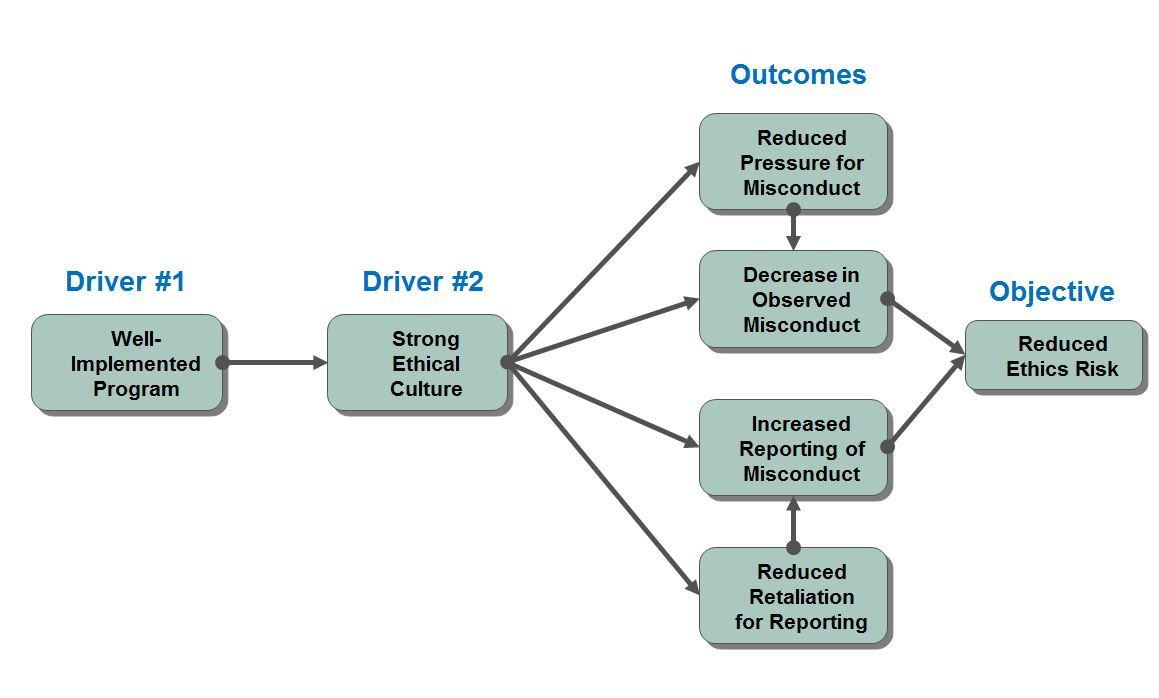
Research from the Ethics & Compliance Initiative (ECI) has demonstrated that organizations with a robust compliance program and a strong ethical culture generate outcomes that reduce business risks.
Findings from the 2007 ERC National Business Ethics Survey
That research, first published in 2007, also found that while a strong culture has a greater effect on the outcomes, that effect is manifested only when a robust program has been put in place first.
In a more recent report (2018), ECI demonstrated an additional benefit of starting with a robust compliance program: the stronger the program, the more employees perceive that they work within an ethical culture. In other words, without any effort towards improving your culture, you improve it by working on your program. As if this wasn’t cool enough, it means that your outcomes will also improve by an order of magnitude.
Let’s test this. Imagine two employees freshly hired in two different organizations where no effort is made on programs or culture, except that one of the organization has a code of ethics. Which employee is more likely to feel like they just joined an ethical organization? Which employee is more likely to pause before doing something that seems wrong to them?
Of course, a code of ethics alone does not make a robust compliance program, nor will it create an ethical culture. The hypothetical above was exaggerated for effect. But when an organization builds a program, drip by drip, with a code and policies and training and controls, etc., it sends a message that it cares about doing the right thing.
So while many organizations today are rushing to work on their culture because that’s what everyone is talking about, they should not neglect the importance of keeping their programs fresh and keeping them front of mind for all their employees.

 The Ethical Leader