What’s it worth to you?

When should we act to prevent corrupt behavior in our company?

When an employee raises a concern? When an internal auditor includes an observation in a report? When outside advisors recommend that you strengthen your internal controls?

The makers of Jim Bean Bourbon chose to wait until they were fined $8.2 million by the U.S. Securities and Exchange Commission and $19.5 million by the Department of Justice.

Somewhere in your company, someone is asking you to spend money right now to improve your controls and your culture. And I bet they are not asking for millions.

When it’s OK to fail

If you are responsible for a space program, almost every element of it must be perfect. Nothing can go wrong with the rockets or the space suit. But if the astronauts’ chicken-noodle-soup-in-a-tube doesn’t quite taste like your grandmother’s recipe, it’s OK.

For every job, some things must be perfect while others don’t have to be. Not having to be perfect opens the door to more experiments, to more ideas. The more ideas you have, the more likely you are to have a good one. Good ideas are fun and exciting and give you a competitive advantage.

Look at what you are working on today. Does it have to be perfect? Can you let your team fail repeatedly until a good idea propels you forward? Do you have (and give) the psychological safety to make mistakes and learn and grow?

In other words, do you operate in a trusting environment?

Just in time

Imagine a world where we don’t put stop signs or traffic lights at dangerous intersections.

Instead, we provide training to all students entering high school, telling them where the dangerous intersections are, hoping they will remember when they first take the wheel a few years later.

Sounds ridiculous?

Yet, many companies train their new employees on antitrust or corruption risks months or years before these employees will attend a trade show or interact with a government customers. Wouldn’t it be better for the training to be provided just before every trade show or customer meeting – as if they were approaching a dangerous intersection?

New employees and new risks

According to this article, most homebuyers are not warned about the new flood or wildfire risk caused by climate change. They know a lot about their new home: quality of schools, access to public transportation, and presence of lead paint. But they don’t know about the rising risks associated with climate change, mostly because the law doesn’t require disclosure.

Which got me thinking: are companies adapting their new employee training and onboarding process to account for the new risks associated with the pandemic and social justice?

Is yours?

Room for real voices

It turns out that cows react more positively to a live human voice than they do to a recording of that same voice. It might be a stretch to assume that humans react the same way but I’m willing to bet $1 that we do.

Personally, I derive a great sense of satisfaction when my wife an I host friends at our house for dinner around the fireplace. That sense is greatly diminished when those friends are on FaceTime (because of COVID). Same people, same conversation, same fireplace in the background. But what we hear and see is effectively a digital recording of the real thing, and we simply don’t react the same way.

If your company is planning its office space for the post-COVID era, consider that, 6 months from now, employees might have a stronger desire for in-person conversations than they have now. Make sure there is room for them.

Equality and equity

I have three kids.

I love them equally.

But I don’t treat them the same because they are not the same. Each has a different personality, different aspirations, different struggles. In some respect, it would be unfair to treat them equally.

In the workplace, this translates to equity. Equity asks us to see each employee as an individual human being. In doing so, it aims for fairness over sameness.

Because no one is the same, except in that we all want to be treated fairly.

Transparency or corruption

I have written before about the corruption risks related to major sporting events like The Olympic Games and The World Cup. Whenever billions of dollars converge on a single event, corruption risks are high.

There is an unusual event these days that is also attracting billions of dollars: the pandemic. Governments all over the world are spending billions every month trying to contain the virus and finding a vaccine. One way to mitigate related corruption risks is to clearly see how these billions are spent.

To that end, the US Congress passed a law earlier this year creating a database that was intended to track all COVID-related monies spent by the US government and to protect taxpayers. However, the current administration found a loophole and awarded $6B of vaccine contracts to a single company without taxpayer protections.

The US government is indicting more companies than ever under the “books and records” provisions of the FCPA (and for good reasons). So why is the same government not following its own advice and being transparent about how it is spending public funds?

On food insecurity

Food insecurity now exceeds 20% in the United States.

Here is what we can do as individuals:

  • Search the internet for our local food bank;
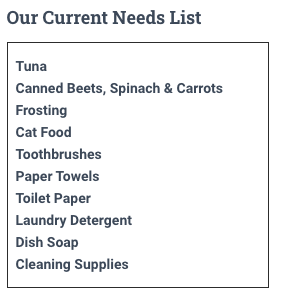
  • Find their wish list on the site, usually right on the landing page. Here’s what my local food bank needs this week:
  • Add a few items to our personal grocery list; and
  • Deliver those items to our food bank. Mine has a drop off lobby that’s open 24/7.

Here is what companies can do:

  • Talk about food insecurity at work and encourage employees to ask for help if they need it.
  • Organize a food drive (best for companies whose employees do not work from home).
  • Make a monthly cash donation to their local food bank (based on a few dollars per employee).

Companies often forget that the communities where they operate are key stakeholders. Hidden in these communities are those who go hungry and the food banks that support them. As ethical leaders, we must see the unseen and do what we can.

The stakeholder that takes care of the others

An article about how a soccer player is trying to save the job of his team’s mascot reminded me of the many job-related acts of generosity I’ve observed during this pandemic.

Many of my friends and colleagues continued to pay their hairdresser and housecleaner for weeks even though they could not get their hair cut or their house cleaned. Others bought gifts cards from their favorite restaurants with no intention of using them later. A friend of mine, whose business is effectively shut down, has continued to pay all of his employees and will continue to do so for another 6 months – when he’ll run out of money.

Companies have many stakeholders, each with their own needs. In good times, satisfying every stakeholder is a delicate balancing act. Providing customers with a generous warranty takes away from shareholders. Paying good dividends to shareholders takes away from charitable donations. No one is ever completely happy. And that’s in good times.

In bad times, the top priority for any company is to be around tomorrow. The next priority is to preserve as many jobs as possible.

Why the focus on employees?

Because employees are the only stakeholders that take care of all the others.

The second rule of the game

In today’s post, Seth Godin reminds us that the first rule of any game should be “All players must agree to not cheat.”

It’s a metaphor for workers, companies, governments and regulators. When only one of them cheats, the others can often contain the damage. When all of them cheat (think 737 MAX), you get a human catastrophe.

Thus, the second rule of the game should be “If a player cheats, no other player will tolerate it.”