How we work depends on why we work

This post is the fifth in a series devoted to my reading notes (and thoughts) on the essays contained in The Culture Book, Volume 1. This essay is from Lindsay McGregor, co-founder of Vega Factor and co-author of the bestselling book Primed to Perform: How to Build the Highest Performing Cultures through the Science of Total Motivation (ToMo). Vega Factor’s mission as a company is that every single organization on Earth has a high-ToMo way of operating and a great culture by 2050. For my 2016 reading notes Primed to Perform, please click here.

Social science uncovered six motives that explain why people work: Play, Purpose, Potential, Emotional Pressure, Economic Pressure and Inertia (For an overview of the six motives, click here). These motives can be measured, and the measures can predict the performance of an individual and of an organization. More specifically, the measures can predict a number of outcomes, including ethical behavior.

Our reasons for working, our “why”, directly affects what we do and how well we do it. Culture is everything that shapes our “why”, all the things in an organization that influence how we show up for work.

Anyone attempting to measure performance must first understand that there are two types of performance: tactical and adaptive. Tactical performance is your ability to execute against plan. Adaptive performance is your ability to diverge from plan, a necessary skill in today’s ever-changing world. Leaders need both types to run an organization effectively. While all six motives can improve tactical performance, only the first three increase adaptive performance. As they set to measure performance, leaders are warned not to “weaponize” the data they collect through dashboards and scorecards. Of course, metrics are necessary but they must be carefully selected, not used to instill fear in their employees, and not necessarily tied to compensation.

The most powerful driver of employee motivation is role design. A role is poorly designed when employees don’t know what they are responsible for, only understand a piece of the problem the organization is trying to solve, don’t see the impact of their work, or don’t have the skills for the job. It should be noted that well-paid does not mean well-designed. When a role is well-designed, employees are trusted to experiment and they see the link between their work and the organization’s mission/purpose
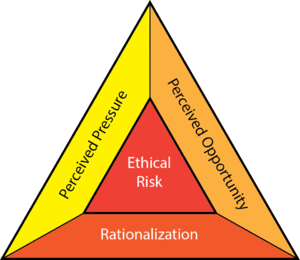
The forgotten sides of the fraud triangle

Fraud_Triangle.png

We have known about the fraud triangle for decades. Fun fact: it has three sides.

Yet, whenever we identify fraud in the organization, our automatic reaction is to work on reducing opportunity. Opportunity is easier to work on. If someone uses the company checkbook to write a check to themselves and embezzle money, we reduce the opportunity by requiring two signatures on checks going forward.

We’ve been working on opportunity (policies, rules, internal controls, audits) for a long time and yet employees still engage in wrongdoing.

Can someone please remind me of the definition of insanity?

I suggest it’s time to focus on pressure (both emotional and economic) and rationalization.

It’s time we re-think how we compensate our employees, how we weaponize data with scorecards that aim to shame our employees into performance, how we operationalize trust.

Addressing pressure and rationalization is a lot more difficult. But most compliance programs have reached the limit in terms of what additional controls can do. In fact, too many controls can add pressure and help rationalize bad behavior.

A good place to start on this new journey is outlined in a fantastic book titled Primed to Perform.

Look around. It’s clear that we need to start performing differently.

Inertia

When I first read Primed to Perform, I had difficulty applying the concept of inertia to ethics & compliance. I later had the chance to meet co-author Neel Doshi, who explained how devastating to compliance inertia can be.

We’ve all seen it but we didn’t know to call it inertia. In compliance, it’s when you ask an employee, following a preventable accident or a violation of law, why they did what they did, and their answer is: “I don’t know. We’ve always done it this way.”

In the business world, the best way to break inertia is to create velocity. We create processes that force innovation. We can do the same in compliance. We can create processes that force us to constantly evaluate the robustness of our program.

What part of your compliance program has been untouched for more than 3 years? This is where inertia is settling in.

Leaders share

If you want to build your brand on social media, the experts recommend that you post at least 6 times a day, on every platform, with a mix of written word, audio and video.

The ethical leader – the one who inspires others to become ethical leaders – follows a similar process. She communicates her ethical awareness (how she recognizes ethical dilemmas) and her ethical decision-making (how she comes to a decision) as often as possible, using as many media as possible.

You will recognize and resolve an ethical dilemma today (if not today, this week for sure). Will you keep quiet, or will you share your experience?

Leadership is calling.

Enjoy your lunch

505b327b6bb3f71349000010-2732-2049

More and more, we eat alone at work.

We eat alone because we are too busy with work, or to catch up on personal business, or to spend time on social media.

We choose to eat alone despite the fact that eating with colleagues can improve connection, communication and trust – elements that can actually boost performance.

Today, why not grab a colleague or two (or three) and eat together? Talk about anything but work. You can even watch this 90-second video. Create tiny bonds of human connection. When difficult times roll in, those bonds might just save the day.

Safety

Where is there uncertainty for your employees today?

Are you battling rumors? Might you lose an important customer? Is a key license at risk? Are you down to three months of cash flow?

If there is an important (and uncomfortable) conversation to be had with your team, don’t walk away from it. When you have these conversations, you build trust. Trusting employees feel safer. Feeling safe is a key ingredient to optimal performance.

We will get hurt

We spend a lot of time asking employees to mind what they do and say so as not to hurt of offend others.

Perhaps there should also be room for us to teach employees how to prepare for hurt and offenses.

Here is one method, borrowed from today’s entry in The Daily Stoic. First, we should not expect to work our entire life without a colleague offending us. This expectation is absolutely ridiculous. Second, we should consider (as in think carefully about) the offenses that can be realistically thrown at us. Third, and clearly most difficult, we should want for these offenses to materialize as an opportunity to practice excellence and virtue.

This teaching reminded me of a story about Ajahn Chah, the famous Thai Buddhist monk:

Before saying a word, he [Ajahn Chah] motioned to a glass at his side. “Do you see this glass?” he asked us. “I love this glass. It holds the water admirably. When the sun shines on it, it reflects the light beautifully. When I tap it, it has a lovely ring. Yet for me, this glass is already broken. When the wind knocks it over or my elbow knocks it off the shelf and it falls to the ground and shatters, I say, ‘Of course.’ But when I understand that this glass is already broken, every minute with it is precious.

When we know – truly know – that someone will eventually offend us at work one day, we can shift our attention to the joyful moments at hand.

Playing in the right game

In game theory, the goal of an infinite game is to keep playing the game.

The problem with many infinite games is that some of the players play it as if it was a finite game, one that must be won and ended by them. These players ruin it for everyone else.

Most founders create their companies in hopes that it will last forever. They start with one product or service and, over time, as people and technology change, they adapt to stay in business. They, along with their suppliers and customers, want the company to be there the next day and the day after that. Ethical leaders and E&C professionals can thrive in such companies.

But then some companies go public and allow a new player in the game: the shareholder. With its infusion of cash, this player offers the illusion that it will lengthen the game but it has no intention of playing an infinite game. It is not even playing a long game. If we are lucky, it is playing a 3-month game. Some are playing only for a day. Or a minute. Or a fraction of a second. And they ruin it for everyone else.

No judgment required

Create a rule and your employees will know what to do in that situation. No judgment required on their part. No responsibility either.

Create enough rules to cover all situations, and your job posts can read: “Seeking bodies. No judgment or responsibility required.”

Never seen a job post like that.

You?