Of targets and measures

“When a measure become a target it ceases to be a good measure.” – Charles Goodhart

A measure brings a sense of calm, of grounding, of knowing where we are.

A target brings a sense of agitation, of shortcoming, of having to catch up.

There’s nothing wrong with having a target but it’s rarely a good measure.

It’s much better to measure the activities that will get us to the target.

And to resist the temptation to morph these measures into targets.

It’s about the process.

Focussing on the process allows us to be patient, yet to move swiftly.

The tortoise did win the race.

Puttin’ on the Ritz

Ritz-Carlton allows its employees to spend up to $2,000 on every guest to ensure a memorable stay. No form required. No approval necessary. No restrictions.

United Airlines could have adopted a similar policy for passengers they overbooked on purpose. Rather, their policy called for a forcible removal.

Some policies make employees feel trusted and some don’t. Some policies call for the employees’ best judgement and some seek to replace it.

Employees respond in kind because culture is an outcome of how we do things.


On humility

“We are wrong. We have been wrong for a long time but we did not know it. Now we know and we will fix it. We apologize and we thank you for bringing this up.”

I recently spoke these words 5 minutes into what was supposed to be a one-hour call to discuss a controversial issue. There were 8 people on the line, three of “us” against five of “them”. The other side was ready for a battle and feared a bad outcome.

The call ended just a few minutes later, with a great sense of relief from the other side.

And a great sense of peace from our side.

Yet another reminder of the awesome power of humility and shared purpose.

Open source

In certain industries, a few professionals believe in the open source model while the majority follow the profit model. Think software, pharmaceuticals, or health studies.

In the E&C sphere, I would argue that most practitioners have adopted an open source model. We share freely our efforts and practices toward establishing ethical cultures in organizations. Furthermore, many E&C consultants publish their studies and guidelines for free for those who wish to go at it alone (and those consultants still generate a decent amount of business).

Despite evidence that a strong ethical culture is a competitive advantage, we collaborate. We do so because we understand the importance of a level-playing field. We want to focus on our contributions to society, not on defending lawsuits. We want trust to be our operating system.

I am grateful to be working in such an environment.

And so I thank you.

I can tell you now, or…

As E&C professionals, many of the problems we face at work result from poor communications.

  • An employee violates a policy she didn’t know existed
  • A manager doesn’t discuss the importance of onboarding training with his new employee, who decides to skip it
  • The team conducting a routine unannounced audit poorly explains the routine nature of the exercise and the local organization goes into a tizzy
  • A new compliance program, which took 2 years to create and significantly changes how things are done, is rolled out with little warning
  • One business unit in France develops a new process in response to a new law and does not share it with sister business units in the same country
  • Employees respond to a survey and never hear about the results

I could go on but you get the point. Poor communications create frustration at best and significant compliance issues at worse. Often, this happens because we think that we have too much to do to waste time telling others about what we are actually doing.

This reminds me of a quote I heard years ago when I didn’t take time to exercise: “If you don’t make time for health now, you better make time for sickness later.” Similarly, when we don’t take a minute to communicate about our E&C initiatives, we often spend hours fixing problems.

The things that matter most

Four days ago, I received some bad news at work. Someone didn’t do a good job on a project I deeply care about and I felt anger and confusion. How could this happen? I decided to sleep on it.

Three days ago, still angry, I scheduled a meeting with the senior leadership of the organization responsible for the bad news. I was planning to provide some “candid” feedback on their performance. “I owe it to them,” I thought.

Two days ago, I had calmed down. I started to rehearse in my head my upcoming meeting and realized it would be best if I approached it differently.

Yesterday, I had the meeting. I spoke  in a spirit of respect, cooperation and humility, remembering how often I have messed up over my career.

Today, I am at peace. Not so much because I got things off my chest. But rather because an important relationship is intact.

And all relationships are important.

Have your pick

Over the last 10 years, I have had the privilege of traveling to 26 different countries (most multiple times), touching every continent except Antarctica.

Some countries are rich and some poor, some have a firm rule of law and some don’t, some tolerate corruption more than others, and others offer more basic human rights than some.

Everywhere I have met happy and hopeful people. Employees who want to do the right thing. Colleagues who understand the importance of rules and values.

Thanks to the internet and mobile devices, organizations now have access to a talent pool of a few billion workers.

It’s never been easier to find and attract those who share our values.

We can have our pick.

What was the last thing you said?

Some leaders talk about the importance of an ethical culture at every opportunity, without prompting. It comes from the heart and employees can feel it.

Some only need a gentle reminder and say all the right things on their own.

Some will include remarks on ethics if and when prepared by the ethics office.

Others won’t ever say a word, until it’s too late.

The employees writing the policies, creating the training, embedding the controls, conducting the audits and investigations – not to mention those doing the day-to-day work of the organization – they all have the leader’s last words on ethics ringing in their ears.

Or they don’t.

Ask me anything

The U.S. Department of State does something pretty unique for a government agency.

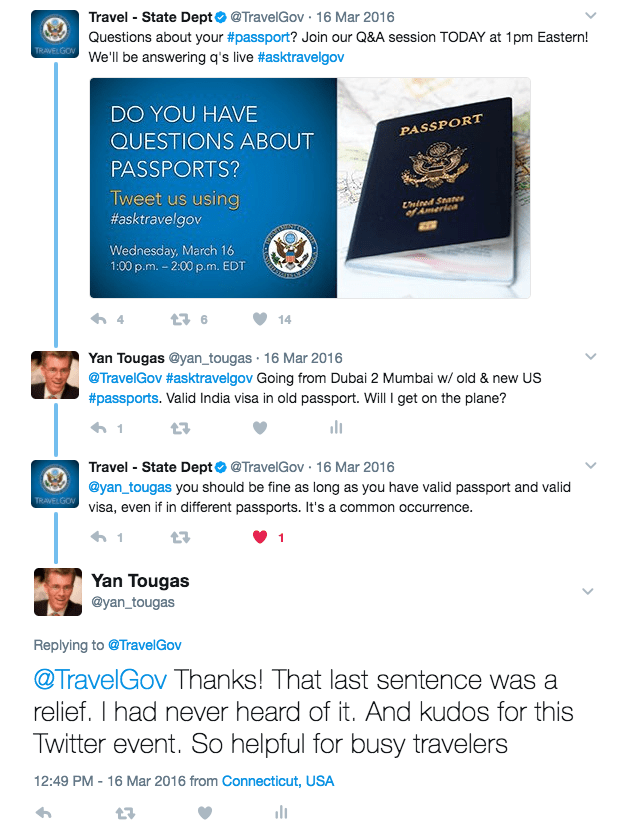
Every few weeks, it holds a Q&A session on Twitter. For one hour, anyone can ask a question about passports and travel.

I have used it in the past and have been delighted. Here’s a screenshot of my conversation:
Screen Shot 2017-04-27 at 7.00.36 AM

I received my answer in 14 minutes. There is no way I could have obtained a response this quickly by email or even by phone (ever tried to call a government agency with a question?).

It turns out that our employees also have a million questions about our E&C program. What is our policy on smoking in the workplace? Do we have a training module on the UKBA? Can internal audit show up unannounced?

They don’t always know who to call or email, or even feel comfortable doing so.

Which is why holding regular AMA sessions can be so beneficial for everyone. Employees get their questions answered and management learns what’s on their employees’ mind.

It’s as simple as holding a one-hour monthly teleconference.


If you already do something like this, please share your experience in the comment section below. If you don’t, give it a try and let us know how it went!